1D Lumped Mason Model · Frequency-domain TVR estimation · Water & Air
The simulation tool is a self-contained HTML file. Open it in any modern browser — no installation required.
Open Simulation Tool ↗This tool estimates the Transmitting Voltage Response (TVR) of a tonpilz-type underwater transducer using a 1D lumped Mason equivalent-circuit model. All calculations run in the browser with no server or external dependency.
The model solves a two-mass / one-spring system in the frequency domain: the tail mass (body + bolt + half PZT stack) and the head mass (piston + optional matching layer + half PZT stack) are coupled through an effective spring that combines PZT stack stiffness, bolt stiffness, piston compliance, and body compliance in series/parallel. Radiation into the surrounding medium is modelled by the exact baffled-piston radiation impedance (Beranek, using Bessel and Struve functions).
TVR is reported in two media simultaneously:
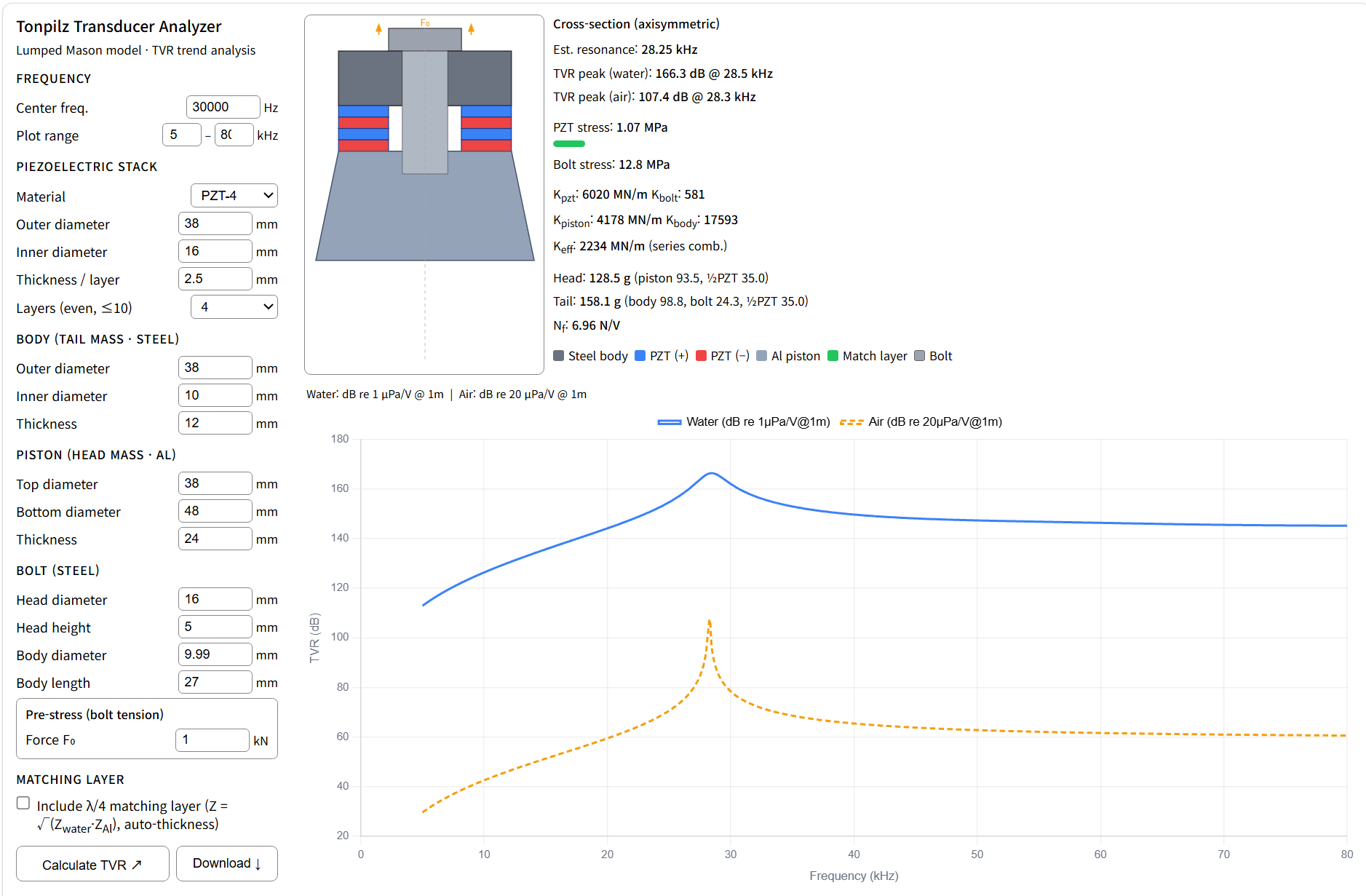
Fig. 1 — Tool interface. Left panel: inputs. Right panel top: cross-section diagram. Right panel bottom: TVR graph.
The screen is divided into two columns:
Freq_kHz / TVR_dB) with a header containing the input parameters.The tool performs basic geometric consistency checks before calculating (e.g. bolt diameter vs. body inner diameter, bolt length vs. stack + body height) and displays an error message if any constraint is violated. The center frequency is restricted to 100 Hz – 100 kHz.
Four spring elements are combined. The PZT stack (short-circuit stiffness) and the pre-stressed bolt act in parallel; that sub-assembly, the piston frustum, and the body cylinder then act in series:
K_eff = 1 / ( 1/K_pzt_bolt + 1/K_piston + 1/K_body )
where K_pzt = A_pzt / (s33_E × h_stack),
K_bolt = E_steel × A_bolt / L_bolt,
K_piston = π × E_Al × r_top × r_bot / h_piston,
K_body = E_steel × A_body / h_body.
Pre-stress modifies the PZT stiffness through a stress-stiffening factor (empirical, ~8 % per unit normalised stress).
The PZT stack mass is split equally between head and tail. Head mass = piston + ½ PZT + matching layer (if present). Tail mass = body + bolt assembly + ½ PZT.
The radiation face is taken as the bottom face of the piston (or matching layer if present). The baffled circular-piston radiation impedance is computed analytically:
Z_rad = ρc × π a² × [ R₁(2ka) + j X₁(2ka) ]
using the exact series expansions for R₁ (Bessel J₁) and X₁ (Struve H₁). This is exact for ka up to any value, not just the low-frequency approximation.
When selected, a quarter-wavelength layer is added at the radiation face.
Its acoustic impedance is set to the geometric mean of water and aluminium:
Z_m = √(Z_water × Z_Al).
Its thickness is h = c_m / (4 × f_center), computed automatically.
The layer is modelled as a transmission-line transformer applied to the
radiation impedance before entering the mechanical network.
The force factor is N_f = d33 × A_pzt / (s33_E × t_layer),
consistent with parallel electrical connection of N layers.
The head-mass velocity v_h is obtained by solving the 2-port Mason network,
and the far-field pressure at 1 m is
p(1m) = ρ c k a² / 2 × |v_h|.
The following geometry is taken from the COMSOL Application Library (Tonpilz Transducer example) and represents a well-proportioned design where the piston outer diameter is close to the PZT outer diameter.
| Component | Parameter | Value |
|---|---|---|
| PZT-4 stack | Outer / inner diameter | 38 / 16 mm |
| Thickness per layer | 2.5 mm | |
| Number of layers | 4 | |
| Body (steel) | Outer / inner diameter | 38 / 10 mm |
| Thickness | 12 mm | |
| Piston (Al) | Top / bottom diameter | 38 / 48 mm |
| Thickness | 24 mm | |
| Bolt (steel) | Head diameter / height | 16 / 5 mm |
| Body diameter / length | 9.99 / 27 mm | |
| Pre-stress | 1 kN | |
| Matching layer | None |
| COMSOL (FEM) | This tool (lumped) | Difference | |
|---|---|---|---|
| Resonance frequency | ~28 kHz | ~28 kHz | ≈ 0 % |
| TVR peak (water) | ~152 dB re 1 μPa/V @ 1m | ~166 dB re 1 μPa/V @ 1m | +14 dB |
A second case uses a smaller geometry where the piston bottom diameter (25 mm) is more than twice the PZT outer diameter (12 mm).
| Component | Parameter | Value |
|---|---|---|
| PZT-4 stack | Outer / inner diameter | 12 / 8 mm |
| Thickness / layers | 2 mm × 4 | |
| Body (steel) | OD / ID / thickness | 16 / 4 / 10 mm |
| Piston (Al) | top ⌀ / bottom ⌀ / thickness | 20 / 25 / 7 mm |
| Bolt | head ⌀×h / body ⌀×L | 8×2 mm / 3.99×20 mm |
| COMSOL (FEM) | This tool (lumped) | |
|---|---|---|
| Resonance frequency | ~8 kHz (primary), ~35 kHz (secondary) | ~44 kHz |
| TVR curve shape | Two distinct peaks; flat plateau between | Single monotone rise to one peak |
| Quantity | Reliability | Notes |
|---|---|---|
| Resonance frequency (valid regime) | Good | Typically within 5–10 % if piston OD ≤ 1.5 × PZT OD |
| TVR curve shape (valid regime) | Good (qualitative) | Peak location and roll-off trend are correctly reproduced |
| TVR absolute level | Poor | Systematically over-predicted; typical offset ~10–15 dB |
| Resonance frequency (invalid regime) | Poor | Can be 2–5× too high when piston flexure dominates |
| Multiple resonance peaks | Not supported | Model produces only one mechanical resonance |
Material constants used in the model: PZT-4 s₃₃E = 15.5×10⁻¹² m²/N, d₃₃ = 289×10⁻¹² C/N, ρ = 7500 kg/m³, Q_m = 500; Steel E = 205 GPa, ρ = 7850 kg/m³; Aluminium E = 70 GPa, ρ = 2700 kg/m³. These are standard handbook values and differ slightly from the COMSOL material library; the difference has a minor effect on resonance frequency (≲ 2 %) and does not explain the TVR amplitude discrepancy.
Tonpilz TVR Analyzer — 1D Lumped Mason Model